
Pointing a gun can get a Virginia assault conviction
Pointing a gun can get a Virginia assault conviction
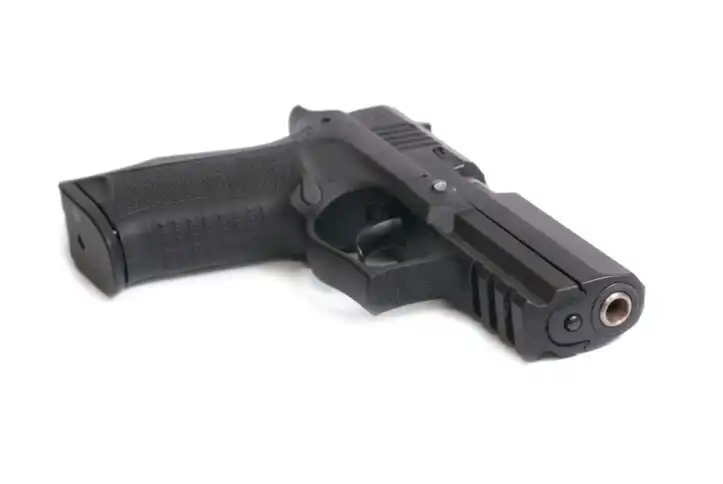
Pointing a gun can lead to a Virginia assault conviction
Pointing a gun at another person risks getting you convicted of assault in Virginia. Duane Eugene Sholl learned that the hard way by being convicted of assaulting a law enforcement officer (a Virginia Class 6 felony) and sentenced to one year of active incarceration. Sholl v. Commonwealth of Virginia, Record No. 1879-24-1 (Va. App. 2026) (unpublished). As a Fairfax criminal lawyer, I see Sholl as vital reading for overcovering risk against a successful assault conviction, let alone a conviction for assaulting a law enforcement officer (LEO), which carries a mandatory minimum of six months incarceration, none of which may be suspended. I often tell my clients to give wide berth to law enforcement officers (LEO’s) to avoid any accidental touching of them, and then a felony assault prosecution. For instance, the Fairfax courthouse hallways are often very crowded, particularly on the second floor when preliminary hearing dates are being handled. All it takes is a large person to accidentally bump into a law enforcement officer to result in an assault prosecution. (As an aside, this is a statutory one-way street of sorts, in that when an LEO I know recently amicably patted me on the arm in the courthouse, I immediately recognized never to do the same to an LEO; I will accept their offer of a handshake or fist bump, but that is it).
Why can I be convicted of assault for merely pointing a handgun at someone without pulling the trigger or saying anything?
When a Virginia criminal defendant is charged with assault for pointing a firearm at someone else, “the Commonwealth must establish that the defendant ‘engaged’ in an overt act intended to place the victim in fear or apprehension of bodily harm,” which did in fact create “such reasonable fear or apprehension in the victim.”‘ [Blankenship v. Commonwealth, 71 Va. App. 608, 620 (2020)]. (quoting Clark v. Commonwealth, 54 Va. App. 120, 128 (2009)).” Sholl. As will become readily apparent, even as a criminal defense lawyer, I know that the following scenario provided more than enough evidence to nix Sholl’s chances of winning on appeal.
Why did a Virginia criminal defendant get convicted of assaulting a police officer by directing a handgun at him?
Duane Sholl is actually very lucky that he survived to see the day of a trial and appeal, in light of all the instances where police open fire on a person pointing a firearm at them. None of the numerous police officers present shot or otherwise harmed Sholl when Sholl pointed his handgun at one of them, which at least Sholl helped avoid by being an apparently short period of training his handgun on an LEO. Police arrived at the accident scene, finding Sholl’s vehicle on its side. One of the LEO’s had reason to believe that Sholl was physically dangerous, had his service weapon drawn when approaching Sholl, told Sholl to show his hands through the open window when Sholl proclaimed being unable to let himself outside of the vehicle, commanded Sholl to stop putting his hands back in the vehicle, and certainly to stop digging around (which apparently involved looking for his firearm). Here are the appellate court-reported details:
“Deputy Tillage explained to the jury that after he asked Sholl to climb out of the van, Sholl ‘crouched back down into the vehicle’ and began ‘rummaging around in the floor.’ Deputy Tillage then instructed Sholl to show his hands and stop ‘digging.’ Sholl then replied, ‘I’m not digging,’ and he showed Deputy Tillage his hands. Deputy Tillage testified that Sholl then ‘reached back into the floor’ and Deputy Tillage ‘heard something slide across the door’ that Sholl was standing on. Deputy Tillage testified that he ‘looked down into the vehicle and [he] saw that there was a gun.’ Deputy Tillage commanded Sholl not to grab the firearm, but Sholl disregarded his command. As a result, Deputy Tillage drew his firearm again and instructed Sholl multiple times to put the gun down. Instead of complying, Sholl stood up, ‘pulled the gun up out of from where he had it by his side[,] and pointed the barrel’ at Deputy Tillage. Deputy Tillage testified that in that moment, he ‘ducked’ and ‘moved away’ because he felt that ‘[Sholl] was going to shoot [him] in the head.’ Deputy Tillage’s body camera showed that Sholl dropped the firearm after multiple other law enforcement officers surrounded the van, leading to Sholl’s arrest.”
What do I do if charged with felony assault of a Virginia law enforcement officer?
Virginia’s felony assault on a law enforcement officer provision covers more than police and of course more than pointing a firearm, and includes but is not limited to: If “any person commits an assault or an assault and battery against another knowing or having reason to know that such other person is a judge, a magistrate, a law-enforcement officer as defined in subsection H, a correctional officer… ” engaged in the performance of his public duties anywhere in the Commonwealth, such person is guilty of a Class 6 felony, and, upon conviction, the sentence of such person shall include a mandatory minimum term of confinement of six months.” Virginia Code § 18.2-57(C).
I suppose that the “engaged in the performance of his public duties” language can be a defense against a felony conviction for when, for instance, one is engaged in a consensual basketball or other game against a police officer or judge, except that the LEO or judge might claim that for whatever reason at the time they were performing public duties. On top of that, expect that sentencing for assaulting such a person can no matter what risk a harsher penalty. Depending on how minor is the alleged assault, threat, and resulting injury; and depending on the police officer involved, the prosecutor’s office involved, and the input of the LEO, sometimes your Virginia criminal defense lawyer can get your felony assault on an LEO charge amended to a more favorable misdemeanor count, and hopefully to an outright dismissal or else a deferred disposition leading to a an assured dismissal for meeting the conditions for doing so. I repeatedly advise clients to engage in relevant self improvement steps that are not admissions of culpability but that can often assist with settlement negotiations and any sentencing.
Fairfax criminal lawyer Jonathan Katz relentlessly pursues your best defense against Virginia felony, misdemeanor & DUI prosecutions. Find out how by scheduling your free, in-person, strictly confidential initial consultation with Jon Katz about your court-pending prosecution at 703-383-1100, Info@KatzJustice.com, and text at 571-406-7268.